


[Yellowish lumps on eyelids] Xanthelasma Treatment

[Yellowish lumps on eyelids] Xanthelasma Treatment
Have you been worried about those yellowish lumps around your eyes and on your eyelids, wondering what they are and if they can be treated? Xanthelasma is a condition where cholesterol deposits accumulate around the eyelids, appearing as noticeable yellowish bumps. Treat prominent, yellowish xanthelasma cleanly with a treatment that precisely targets lesions around the eyes. *VAT separate
Options
Treatment Details


[Yellow Lumps Around Your Eyes?] Xanthelasma Treatment
Yellow lumps around your eyes and eyelids – wondering what they are and if they can be treated?
Xanthelasma is a lesion that appears as yellowish, raised bumps on the skin around the eyelids due to the deposition of cholesterol and lipid components.
Because it is a condition that is not flat but convex, topical treatments alone will not make it disappear easily. Precise laser treatment, tailored to the depth and extent of the lesion, is absolutely necessary.
Kkeut Clinic uses a dual laser technique, combining Er:YAG and CO2 lasers, to effectively treat yellowish, raised xanthelasma.
Kkeut Clinic's Xanthelasma Dual Laser Technique
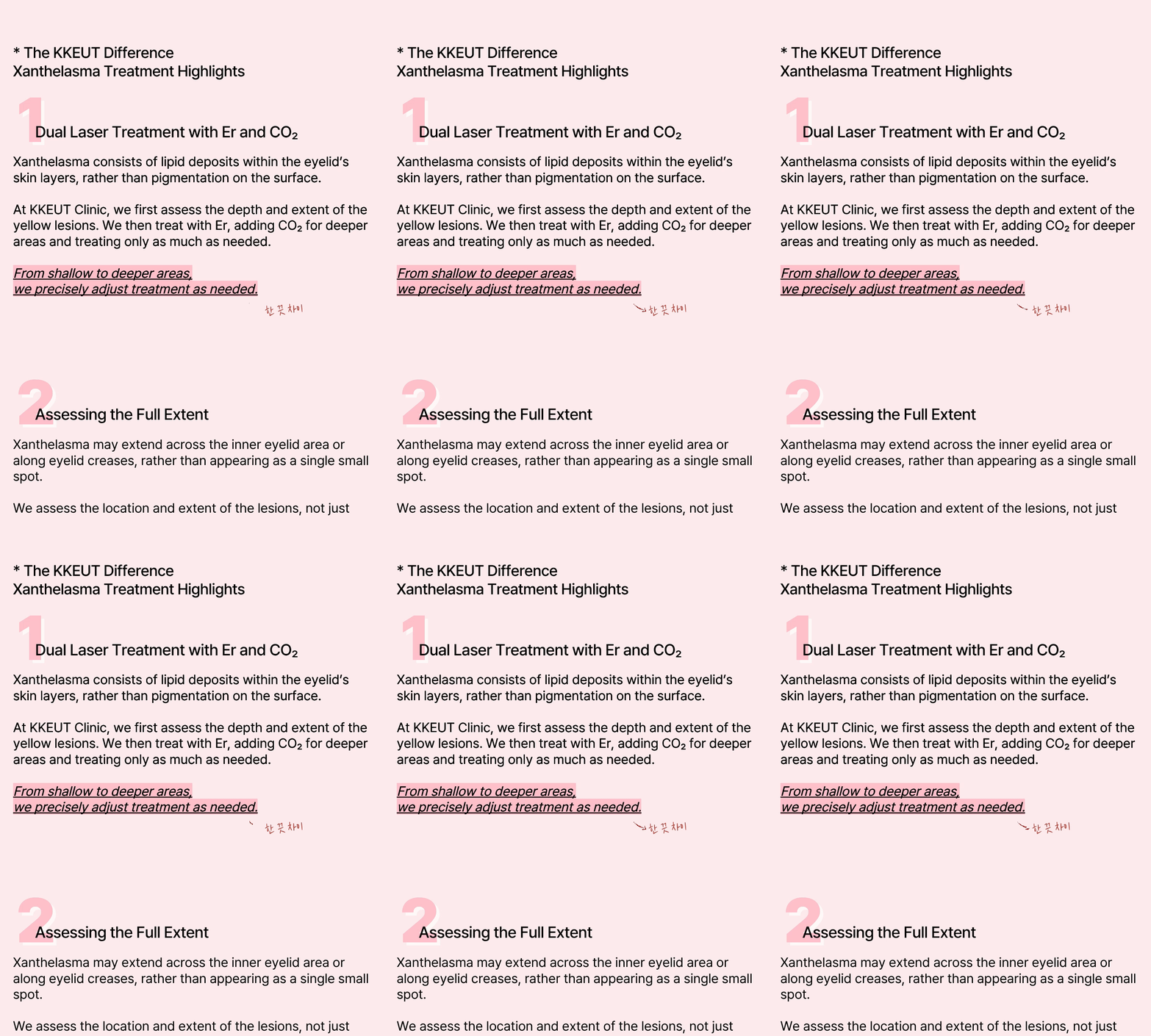
Kkeut Clinic's xanthelasma treatment is not simply a procedure that indiscriminately scrapes away the yellow areas deeply.
Because the eyelids are a thin and sensitive area of skin, the laser must be delicately controlled, taking into account the lesion's thickness, deposition depth, skin texture around the eyes, and potential for scarring.
Therefore, Kkeut Clinic approaches treatment by precisely refining the surface and a certain depth with an Er:YAG laser, and finishing with a CO2 laser if the lesion is located deeper.
1. First, design the scope and thickness of the lesion
Although xanthelasma may appear as small yellow lumps on the eyelids, they often spread widely under the skin or have indistinct, continuous borders.
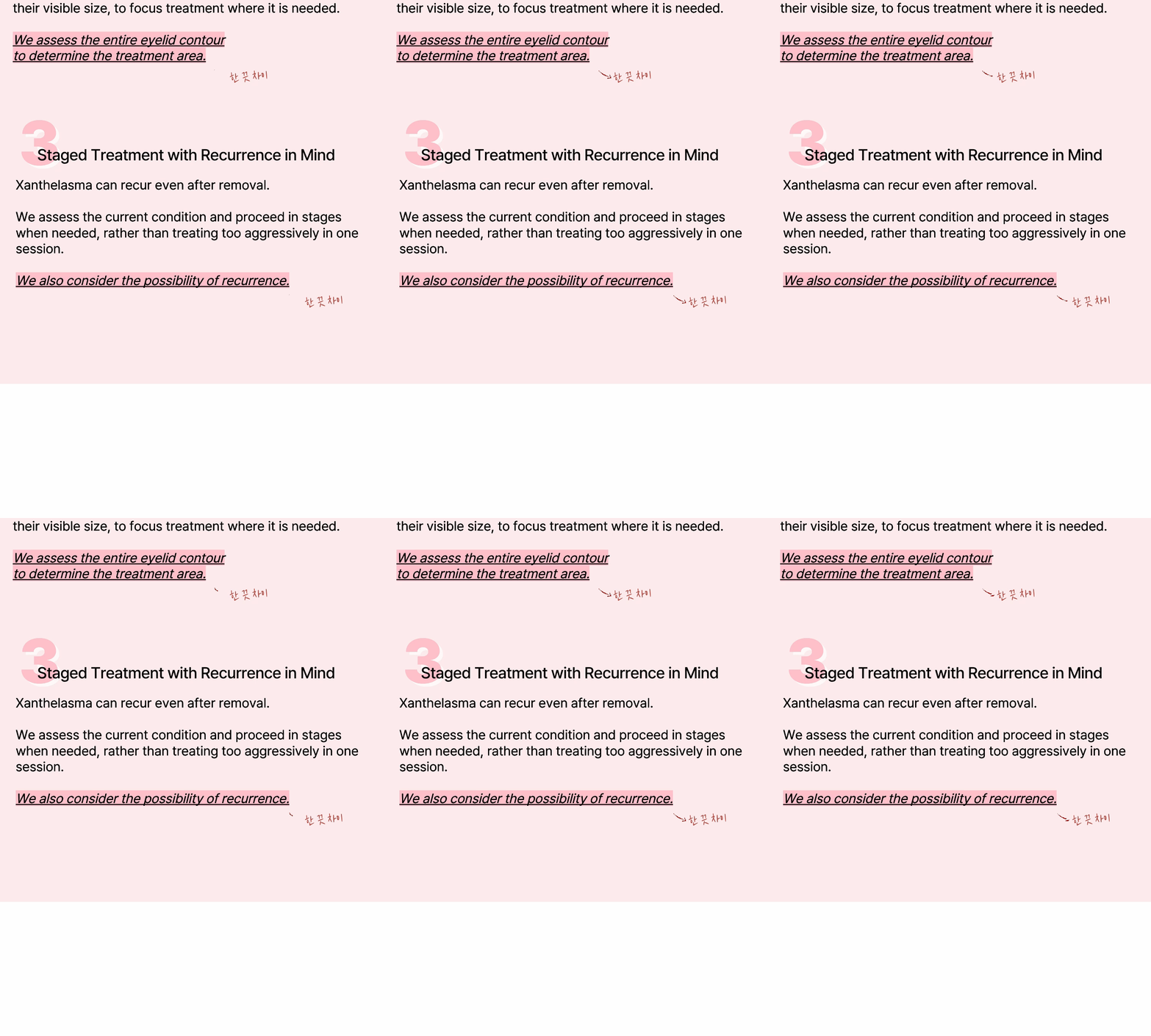
Before the procedure, Kkeut Clinic considers the removal area not just by looking at the visible yellow parts, but also by checking the lesion's thickness, spread direction, and the eyelid crease lines.
The outwardly protruding parts are neatly reduced, and the borders are delicately refined to blend naturally with the surrounding skin.
2. Precise, Layer-by-Layer Removal with Minimal Scarring Using Er:YAG Laser
The Er:YAG laser is suitable for precise epidermal abrasion, which involves thinly shaving off the skin, and is utilized for delicate removal of lesions in thin and sensitive areas like around the eyes.
The Er:YAG laser has reported advantages in precise removal and recovery aspects for xanthelasma treatment.
Kkeut Clinic does not deeply excavate the yellow deposited area all at once, but instead removes it layer by layer, checking thinly from the surface.
This approach allows for natural reduction of the lesion, matching the skin texture around the eyes, while minimizing damage to healthy skin.
3. Finishing the Base and Borders with CO2 Laser When Necessary
Even if only the visible yellow part of xanthelasma is removed, if deposited tissue remains at the base, it can reappear.
The CO2 laser can be used to vaporize and cauterize lesions, and is reported as one of the treatment options for xanthelasma.
However, it is not the primary option as redness and scarring tend to last longer compared to Er:YAG.
Kkeut Clinic precisely refines the lesion with Er:YAG, and if necessary, lightly finishes the base and borders, which are prone to leaving residue, with a CO2 laser.
Instead of indiscriminately burning strongly, the output and irradiation area are finely adjusted according to the depth of the lesion and the condition of the eyelid skin.
4. Natural Finish Considering Eye Area Skin Texture
Xanthelasma treatment doesn't end with merely "removing the yellow parts".
Because even small scars or color differences are noticeable on the eyelids, a finish that blends with the surrounding skin, ensuring a smooth skin surface after removal, is crucial.
Kkeut Clinic treats not only the central part of the lesion but also gently refines the borders, so that the eye area lines can recover as naturally as possible after the procedure.
5. Treatment Plan Considering the Possibility of Recurrence
Xanthelasma is a lesion that can recur even after removal. Especially if it's related to lipid metabolism or cholesterol levels, it can reappear after treatment, so it's advisable to consider blood tests or lifestyle management together when necessary.
Kkeut Clinic assesses the size and depth of the lesion and guides a treatment approach that reduces the risk of scarring and hyperpigmentation by treating it in stages when necessary, rather than attempting aggressive deep removal all at once.
We believe that the beautiful recovery of the eye area skin is as important as neat removal.
Xanthelasma Dual Laser: These are the benefits
Removal of yellow deposited lesions around the eyes with minimal scarring
Thin and precise layer-by-layer abrasion with Er:YAG laser
Ability to finish the base and borders with CO2 laser
Delicate power adjustment tailored for thin and sensitive areas like the eyelids
Customized procedure according to the size and depth of the lesion
Refinement of borders that blend naturally with the surrounding skin
Improvement of protrusion, yellow discoloration, and untidy eye area impression
Recommended for those who
have yellow lumps on their eyelids or around their eyes
thought it was melasma, but it appears yellow and raised
are concerned about yellow lesions around their eyes that are not easily covered by makeup
feel that the lesions are gradually getting larger over time
are worried about scars or hyperpigmentation because it's around the eyes
had it removed in the past, but it reappeared in the same area
want precise removal with a laser rather than surgery
are concerned that yellow lesions around their eyes make them look tired or older
Procedure Steps
STEP 01. 1:1 Customized Consultation
We check if the yellow lesions around your eyes are xanthelasma, and assess the extent and depth of the lesions.
STEP 02. Preparing the Treatment Area
The skin around the eyes is thoroughly cleaned, and the area to be removed is designed.
STEP 03. Anesthetic Cream Application
Anesthesia is applied to minimize pain around the eyelids.
STEP 04. Precise Er:YAG Laser Removal
The yellow deposits are precisely removed layer by layer, starting from the surface.
STEP 05. CO2 Laser Finish
If necessary, the base and borders are lightly cauterized to clear any remaining lesions.
STEP 06. Regenerative Cream
Post-Procedure Precautions
ㆍAfter the procedure, redness, swelling, stinging, weeping, and small scabs may occur.
ㆍDo not forcibly remove scabs; allow them to fall off naturally.
ㆍKeep the treated area from drying out and manage it with a regenerating cream or DuoDERM, DuoGEL products.
ㆍAvoid rubbing your eyes or vigorously scrubbing the area.
ㆍUntil the treated area has healed, it is best to avoid using colored makeup, eyeshadow, and eyeliner.
ㆍPlease avoid jjimjilbangs (Korean saunas), saunas, swimming, alcohol consumption, and smoking for approximately one week.
ㆍUV exposure can cause hyperpigmentation, so please pay attention to sun protection.
ㆍIf the lesion is deep or wide, repeated procedures may be necessary.
ㆍXanthelasma palpebrarum may recur depending on one's constitution or lipid metabolism status.
Procedure Process
See each step, from your first consultation to completion.
- 01
Self-cleansing
- 02
Customized consultation
- 03
Application of anesthetic cream
- 04
Lesion removal procedure
Treatment Basics
Treatment time, anesthesia, recovery and how long results last, at a glance.
TIME
Varies depending on size
ANESTHESIA
Anesthetic cream (15-30 minutes)
RECOVERY
Avoid washing face on the same day as much as possible
Ideal For
One Fine Difference makes real results.
- KKEUT POINT 01
Those who desire clear skin free of lesions
- KKEUT POINT 02
Those who wish to treat yellowish lumps on or around the eyelids, xanthelasma
Q&A
Answers to the questions we hear most.
What is the removal process like?

First, we assess the depth and extent of the xanthelasma through consultation and then proceed with an Er:YAG laser. For deeper areas, we also use a CO2 laser to finely adjust and treat as needed.
Does xanthelasma recur?
Xanthelasma is known to have a recurrence rate of about 40% after treatment, although it varies depending on the depth. Especially if it's related to lipid metabolism or cholesterol levels, it may reappear after the procedure, so it's advisable to consider blood tests or lifestyle management if necessary. Kkeut Hanuiwon guides a step-by-step treatment approach, considering the size and depth of the lesion, to reduce the risk of scarring and pigmentation, rather than attempting to remove it too deeply at once.
Cautions
Results = Treatment × Aftercare. Please follow the notes below.
For one week after the procedure, please avoid alcohol, smoking, saunas, and strenuous exercise.
To prevent hyperpigmentation in the treated area, minimize sun exposure and diligently apply sunscreen.
Please avoid washing your face on the day of the procedure.